
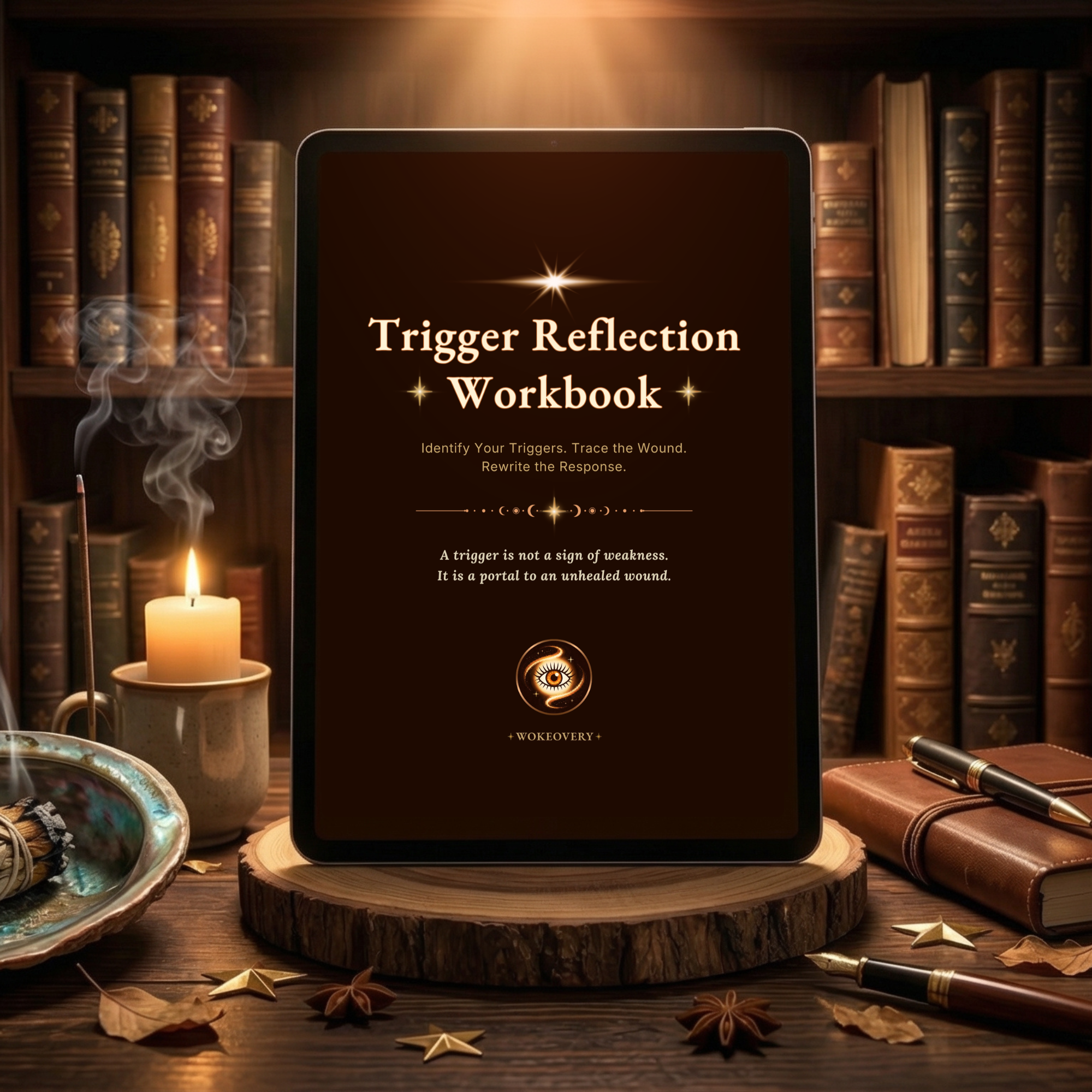
The Trigger Reflection Workbook
Identify Your Triggers. Trace the Wound. Rewrite the Response.
$12.00
🔥 The Trigger Reflection Workbook — Identify Your Triggers. Trace the Wound. Rewrite the Response.
"You are not overreacting to the present. You are re-experiencing the past."
It happens before you can stop it.
A comment. A tone. A silence that lasts half a second too long — and suddenly your chest is tight, your jaw is locked, and you're either defending yourself with a fury that doesn't match the moment, or apologizing for something you didn't do.
Afterward, the shame arrives. Why did I react like that? What is wrong with me?
Nothing is wrong with you. Your nervous system is time-traveling.
What you call "overreacting" is your body activating the exact survival response it learned in a home where a tone of voice could mean danger. The reaction is not about the present moment. It is about the moment it was born.
This workbook helps you find that moment — and build a new response from the ground up.
🔥 What This Workbook Is
The Trigger Reflection Workbook is a 55-page, trauma-informed, clinically grounded workbook designed for women who are tired of being hijacked by emotional reactions they can't explain — and ready to trace those reactions back to their origin.
This is not theory. This is not passive reflection. This is a real-time intervention tool.
You will map your five most activated triggers with surgical precision — the event, the body sensation, the emotional flood, the behavioral response, the childhood belief underneath, and the original wound it connects to. Then you will create a personalized response protocol for each one — so that the next time a trigger fires, you are not ambushed. You are prepared.
📖 What's Inside
A Letter Before You Begin
A grounding welcome that names what you're about to do and why it matters — because this work requires honesty, and honesty requires safety.
Creating Your Safe Container
Before you touch a single trigger, you'll define what safety looks like for you — your safe space, your grounding object, your trusted person, your anchor phrase. This is your foundation. You'll return to it.
Part One — Understanding Triggers (Pages 8–12)
Learn what a trigger actually is — not an emotional overreaction, but a neurobiological event. Your amygdala activating before your conscious mind can assess the situation. Understand the four components of every trigger response: the activating event, the body sensation, the emotional flood, and the old story underneath. Identify your default patterns — fight, flight, freeze, or fawn — and recognize which survival strategy your nervous system learned first.
Part Two — Trigger Mapping (Pages 13–33)
Five complete trigger mapping exercises — each one a full excavation. For every trigger, you will name it, describe the activating event with precision, locate where you feel it in your body, identify the surface emotion, recognize your behavioral response, and uncover the childhood belief that fuels it. Each trigger includes dedicated reflection space and deeper inquiry questions: How intense is this trigger? Who is most likely to activate it? What do you need in that moment — but never receive?
Part Three — Origin Tracing (Pages 34–44)
Connect each of your five triggers to its childhood root. This is where the real work lives. You will close your eyes, let your body lead you to the memory, and name what happened — who was there, how old you were, what you decided about yourself in that moment. Then trace how that wound became a survival strategy, how it followed you into adulthood, and what you would say to the child who first experienced it.
Part Four — Response Protocol (Pages 45–50)
For each of your five triggers, you will build a conscious response template — a new protocol you can return to in real time when the trigger fires. You'll name the trigger, the body sensation, the old story, what your younger self needed, your new chosen response, and an anchoring phrase to bring you back to the present. This is where reaction becomes response.
Part Five — Emergency Grounding (Pages 51–55)
A complete emergency grounding protocol for when the work — or a trigger — overwhelms you. Includes 5-4-3-2-1 sensory grounding, breath anchor technique, bilateral tapping, containment visualization, and a cognitive anchor script. Plus a customizable personal grounding plan so you don't have to think clearly in the moment — you just follow what you've already written.
💡 What Makes This Workbook Different
It is designed to be used in real time. Unlike a journal you sit with in the morning, this workbook is built to be opened when a trigger happens — or as soon after as possible.
Each Day Includes:
A Psychological Insight — clinical context for what is happening in your nervous system, explained with precision and zero fluff
A Structured Mapping Framework — the same six-component anatomy applied to each trigger, building pattern recognition across your five most activated responses
Origin Tracing Prompts — body-led, memory-specific questions designed to locate the birth story of each trigger
A Response Protocol Template — actionable, concrete, written in your own words, ready to be used the next time your nervous system tries to drag you back in time
Dedicated Writing Space — room to write without judgment, because what surfaces is not a verdict — it is information
🖤 This Workbook Is For You If:
You keep having emotional reactions that feel disproportionate to the situation — and you're tired of not understanding why
You've been told you're "overreacting" so many times you started believing it — but your body knows the truth
You can identify that you're triggered but you don't know what the trigger actually connects to or where it was born
You default to fight, flight, freeze, or fawn before you can think — and you want to build a conscious alternative
You've done some of the naming work and you're ready for a practical, structured tool that bridges awareness and real-time change
You want something you can open in the moment — not just reflect on later
🚫 This Workbook Is NOT For You If:
You haven't yet started naming your patterns — begin with the 7 Shadow Patterns guide or the Self-Abandonment Checklist first
You want a passive reflection journal — this is an active intervention tool with structure and precision
You're currently in acute crisis — this workbook is a companion, not a clinician, and some exercises may surface intense material that requires professional support
You're looking for a one-time fix — trigger work is ongoing, and this workbook is designed to be returned to as new triggers surface
✨ What Women Are Experiencing With This Workbook
The moment they realize the reaction was never about the present — it was about a five-year-old who learned that speaking up was dangerous.
The relief of finally understanding why a specific tone of voice sends them spiraling — and having a written protocol to meet it differently.
The power of holding a page that says: this is the trigger, this is where it lives in my body, this is the wound it connects to, and this is who I choose to be now.
💡 Where This Fits in Your Healing Journey
The 7 Shadow Patterns Guide (free) names the patterns keeping you stuck.
The Self-Abandonment Checklist (free) helps you see where you're betraying yourself.
The Shadow Work Journal traces those patterns back to their roots through 30 days of guided self-inquiry.
The Trigger Reflection Workbook gives you a real-time tool for the moments when the wound shows up uninvited — so you can stop reacting from the past and start responding from the woman you are becoming.
The Shadow Integration Workbook takes you deeper — into somatic healing, family-system mapping, parts work, and 30 days of embodied integration.
🕯️ A Note From Wokeovery
You will not eliminate your triggers. That is not the goal, and anyone who promises you that is lying.
The goal is recognition. The goal is the half-second pause between the trigger firing and your response — the moment where you realize this is the wound talking, not the present moment. That pause did not exist before. Now it does.
And in that pause — that is where your freedom lives.
Go at your own pace. Some triggers will map easily. Others will take you somewhere your nervous system has been protecting you from for decades. If that happens, turn to the Emergency Grounding Protocol. Use it. Then come back when you are ready.
One thing I ask: do not judge what surfaces. A trigger is information, not a verdict. Every reaction you have ever had made sense in the context it was created.
You are not the triggered response. You are the woman who learned to see it.
With fierce tenderness,
Wokeovery 🖤
Woke to the wound. Recovering the self.
📥 Instant digital download — 55 pages of clinically grounded trigger mapping, origin tracing, and response protocol work. Keep it close. Open it when the wound shows up.